


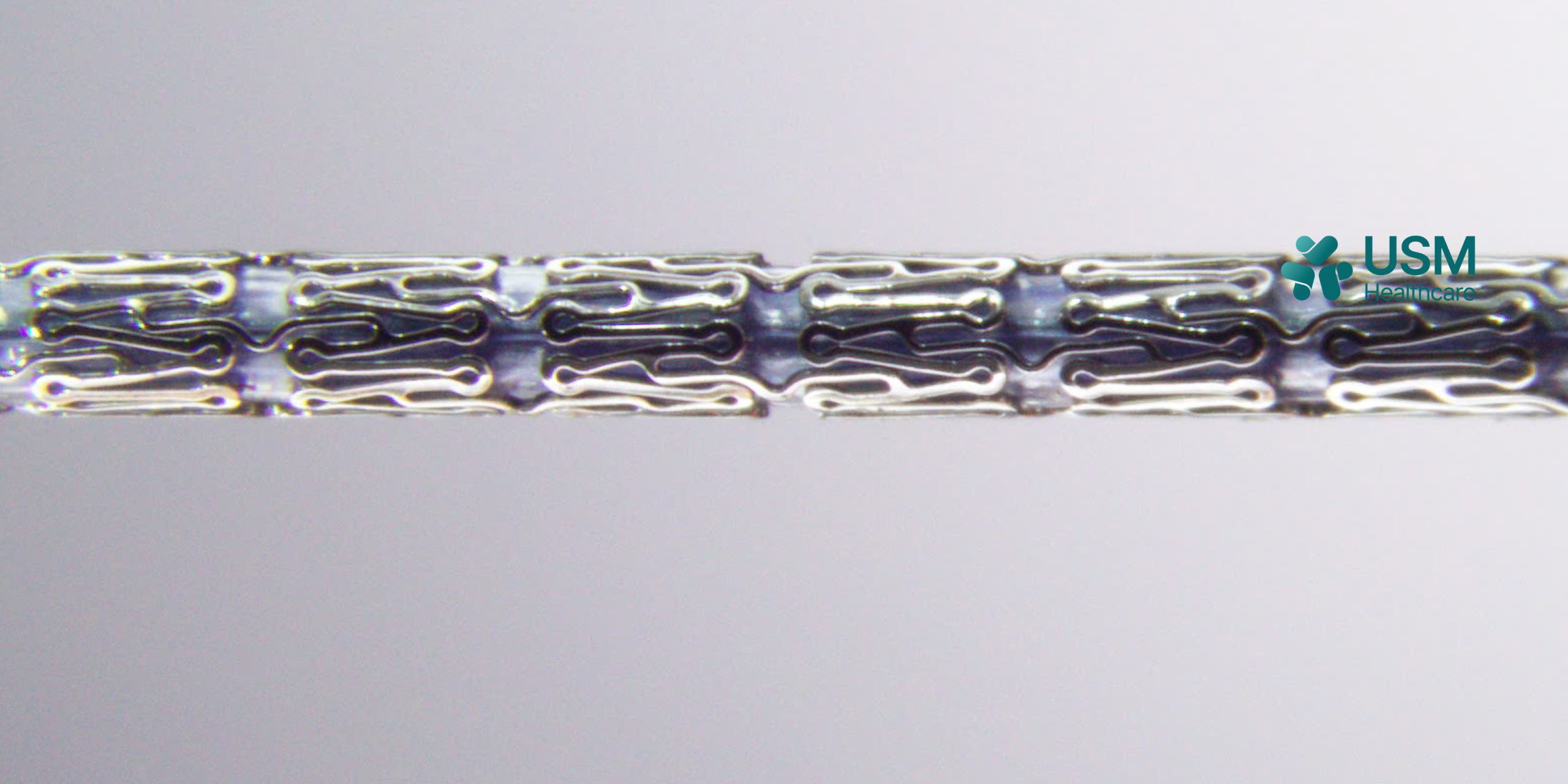
[Series: Quality by design] EPISODE 1: CONTROL THE PROCESS, NOT JUST THE OUTPUT
Comprehensive Quality Control Throughout the Coronary Stent Manufacturing Process
In medical device manufacturing, where stringent standards and regulatory requirements apply, quality control is paramount. This is particularly critical for high-risk medical devices such as coronary stents.
For decades, traditional manufacturing industries relied heavily on end-of-line quality inspection—screening finished products to identify and eliminate non-conforming units. However, in modern medical technology, relying solely on final inspection as the primary means of assuring product quality presents significant risks.
True quality cannot simply be “inspected into” a product at the final stage. It must be designed, optimized, and continuously controlled throughout every stage of the manufacturing process. A compliant, high-quality finished product is the natural outcome of a process in which stability, repeatability, and control are established from the outset.

- Why is final inspection alone not enough?
Final product inspection serves an essential regulatory function: it provides formal verification that a finished product batch meets predefined specifications before release. However, treating final inspection as the primary line of defense for quality can create systemic vulnerabilities.
Limitations of relying solely on end-of-line inspection
For micro-structured devices such as coronary stents—where critical dimensions are measured in micrometers—end-of-line inspection has several inherent limitations:
- Inability to detect all defects comprehensively: Visual inspection, dimensional measurement, and non-destructive testing of finished products may not always detect microcracks or non-uniformities within the drug-coating structure.
- Waste of raw materials and manufacturing costs: Detecting defective products only after all manufacturing stages have been completed means that costly raw materials, machine operating time, and specialized labor have already been consumed.
In medical device manufacturing, a process that relies entirely on sorting products into “conforming” and “non-conforming” categories is inherently unstable. Instead, the manufacturing process itself must be tightly controlled to prevent defects from occurring at the source.
- Key Pillars of an Optimized Manufacturing Process
2.1. Rigorous Control of Incoming Materials
The quality of a coronary stent is strongly influenced by the purity and consistency of its raw materials.
- Traceability and consistency: Each batch of raw materials must be accompanied by complete supplier certification and clearly documented traceability records to minimize quality variation between supply batches.
- Incoming material inspection: Manufacturers should not rely solely on supplier certificates. Incoming materials must also undergo independent inspection and verification by the manufacturer. For high-risk products such as coronary stents, numerous parameters must be controlled, ranging from basic criteria such as appearance, dimensions, and mechanical properties to more complex requirements including chemical composition, impurities, qualitative and quantitative analysis, microbiological parameters, and microscopic cleanliness. Any material batch that fails to meet specified quality requirements must be rejected or returned to the supplier.
2.2. Strict Control of Process Parameters and In-Process Quality
In coronary stent manufacturing, even minor variations in equipment operating parameters can affect the characteristics and quality of the final product. Maintaining precision at every stage therefore requires strict control throughout the entire manufacturing process.
Key manufacturing stages and critical parameters include:
- Laser cutting: Control of peak power, laser pulse frequency, laser pulse width, ambient temperature, and other critical parameters.
- Heat Treatment (Annealing): Control of furnace temperature, treatment temperature, vacuum pressure, heating time, heating power, and other process parameters.
- Electropolishing: Control of chemical composition and mixing ratio, treatment temperature, processing time, polishing frequency, and other critical parameters.
- Drug coating: Control of coating solution formulation, distance between the stent and spray gun tip, nitrogen gas (N₂) pressure, solution flow rate, spray angle, and other coating parameters.
At each stage, semi-finished products undergo In-Process Quality Control (IPQC) against predefined acceptance criteria. Conforming products proceed to the next manufacturing stage, while non-conforming products are reworked or rejected in accordance with established quality procedures.
- USM Healthcare: Standardizing Processes, Optimizing Quality
As a pioneering Vietnamese manufacturer of cardiovascular interventional medical devices, USM Healthcare has established cleanroom facilities, automated production lines, and a quality management system built on comprehensive process control.
At USM Healthcare, manufacturing processes and testing methods undergo rigorous validation. Quality control criteria are established based on risk assessment in accordance with ISO 14971, while also complying with applicable Vietnamese and international regulatory requirements.
This comprehensive approach helps ensure that every product released from our manufacturing facility meets stringent quality standards and the requirements of both domestic and international markets.
Mastery of coronary stent manufacturing technology—particularly for Class D medical devices, the highest-risk classification under Vietnamese regulations—demonstrates USM Healthcare’s advanced technical capabilities and commitment to quality.
We are committed to providing healthcare professionals with products developed to high standards of safety and reliability, supporting our mission to protect patient health and contribute to a better quality of life.
